Home-page - Icelandic Meteorological Office
Weather forecast
Weather forecast for the next 24 hours
Today it will be Westerly or variable winds 3-10 m/s. Mostly fair in the Northeastpart and temp. to 18 deg. C. Elsewere; partly or mostly cloudy with some scattered light rainshowers in the northwest and southeast and Temp, 7 to 14 deg. C.
Tomorrow there will be a variable winds 3-8 m/s. Mostly fair in the east part of Iceland, but cloudy or partly cloudy elsewhere and some showers, specially in the afternoon. Temperature 8 to 17 deg. C, warmest in the northeast.
Forecast made 25.08.2026 07:39
If the map and the text forecast differs, then the text forecast applies
Forecast for station - 1
Forecast for station - 2
Forecast for station - 3
Forecast for station - 4
Forecast for station - 5
Maximum wind in Iceland today
| Lowlands | |
|---|---|
| Highlands | |
|---|---|
Maximum and minimum temperature in Iceland today
| Lowlands | |
|---|---|
| Highlands | |
|---|---|
Maximum precipitation in Iceland today
| Lowlands | |
|---|---|
| Highlands | |
|---|---|
Maximum wind in Iceland during the last hour
| Lowlands | |
|---|---|
| Highlands | |
|---|---|
Maximum and minimum temperature in Iceland during the last hour
| Lowlands | |
|---|---|
| Highlands | |
|---|---|
Maximum precipitation in Iceland during the last hour
| Lowlands | |
|---|---|
| Highlands | |
|---|---|
Preliminary results
Earthquakes
Earthquakes during last 48 hours. at 25 Aug 09:05 GMT


Biggest earthquakes during the last 48 hours
| Size | Time | Quality | Location |
|---|---|---|---|
| 4.1 | 25 Aug 03:38:08 | Checked | 5.1 km WSW of Geirfugladrangur |
| 3.6 | 25 Aug 05:49:37 | 50.0 | 5.0 km NW of Geirfuglasker |
| 3.5 | 25 Aug 06:19:35 | 50.0 | 176.3 km SW of Eldeyjarboði |
Specialist remark
Early this morning at 3:38am an earthquake of M4.5 was detected some 26 km WSW of Eldey on the North-Atlantic ridge. It was a trigger for a seismic swarm that is still ongoing. Last time an event of this magnitude was detected there was on March 23rd of this year.
The event is located on the North-Atlantic ridge due to tectonic movements there. Seismic swarms and earthquakes are regularly detected in this area.
Written by a specialist at 25 Aug 07:19 GMT
Week overview -
Earthquake activity throughout the country is described in a weekly summary that is written by a Natural Hazard Specialist. The weekly summary is published on the web every Tuesday. It covers the activity of the previous week in all seismic areas and volcanic systems in the country. If earthquake swarms are ongoing or significant events such as larger earthquakes have occurred during the week, they are specifically discussed. More
Hydrology
Average flow and temperature last 24 hours
| River | Place | Flow | Water temperature |
|---|
Remarks of a specialist
A small glacial outburst flood began on the 23rd of August in the Jökulsá á Sólheimasandi river, it appears to be subsiding. This has happened a few times this summer in rivers by Mýrdalsjökull. Geothermal gasses could be noticed in the vicinity.
Due to malfunction we have turned off the service publishing hydrological data on the map. Instead see the data using our Rauntímavöktunarkerfi.
Written by a specialist at 24 Aug 16:45 GMT
Avalanche forecasts are now published on Icelandic Met Office’s new website:
New avalanche pages on gottvedur.is/en
News from the Icelandic Met Office’s landslide monitoring service are now published on a new site for landslide warnings on gottvedur.is
News
Increased discharge and significant gas pollution in Múlakvísl
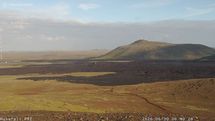
Situation on the Reykjanes Peninsula
Magma accumulation and ground uplift continue beneath Svartsengi. The average rate of magma accumulation over the past few weeks has remained steady.
The most likely scenario remains continued slow magma accumulation, eventually leading to a new dike intrusion and possibly a volcanic eruption.
Read more
Measurements show that uplift at Askja has ceased
Measurements by the lake in Askja. Fieldwork in the area was completed this week, and the results indicate that the uplift episode that began in 2021 has ended.
Read moreIncreased hazard due to changing conditions at the margin of Sólheimajökull glacier
Recent changes at the terminus of Sólheimajökull call for increased caution. Unstable glacier ice and rockfall from the surrounding slopes may pose a risk to people visiting the area.
Read more
Ground uplift and magma accumulation continue beneath Svartsengi

The Icelandic Met Office receives international grant to strengthen aviation safety in relation to volcanic hazards
In October 2025, the Icelandic Meteorological Office (IMO) received a grant of ISK 147 million from the International Civil Aviation Organization (ICAO) for four new development projects in the fields of volcanic hazards and aviation safety. The projects involve, among other things, the development of new measurement methods, automatic analysis of eruption plumes, coordination of responses among European volcano observatories, and research into the effects of sulphur dioxide (SO₂) on aviation.
Read moreShort articles

HARMONIE - numerical weather prediction model
HARMONIE is a numerical weather prediction model (NWP) that is non-hydrostatic and convection-permitting. It is operated at 2.5 km horizontal resolution over a domain that covers Iceland and the surrounding seas. At this resolution it is possible to simulate explicitly some processes that are important for clouds and precipitation as well as meteorological phenomena related to up- and downdrafts. In order to simulate the interaction between the atmosphere and the surface, the model takes into account different types of land surface as well as processes in and at the surface.
Read moreNew publications and research
- Guðrún Nína Petersen (2025). Alviðruhamrar - Meteorological conditions
- Michelle Parks, Freysteinn Sigmundsson, Vincent Drouin, Ásta R. Hjartardóttir, Halldór Geirsson, Andrew Hooper, Kristín S. Vogfjörð, Benedikt G. Ófeigsson, Sigrún Hreinsdóttir, Esther H. Jensen, Páll Einarsson, Sara Barsotti & Hildur M. Friðriksdóttir. (2023).
- Sahar Rahpeyma, Benedikt Halldórsson, Birgir Hrafnkelsson & Atefe Darzi. (2023). Frequency-dependent site amplification functions for key geological units in Iceland from a Bayesian hierarchical model for earthquake strong-motions.
- Sara Klaasen, Solvi Thrastarson, Yesim Cubuk-Sabuncu, Kristín Jónsdóttir, Lars Gebraad, Patrick Paitz & Andreas Fichtner. Subclacial volvano monitoring with fiber-optic sensing: Grímsvötn, Iceland. (2023).
- Ismael Vera Rodriquez, Marius P. Isken, Torsten Dahm, Oliver D. Lamb, Sin-Mei Wu, Sigríður Kristjánsdóttir, Kristín Jónsdóttir, Pilar Sanchez-Pastor, John Clinton, Christopher Wollin, Alan F. Baird, Andreas Wuestefeld, Beat Booz, Eva P.S.Eibl, Sebastian Heimann, Bettina P. Goertz-Allmann, Philippe Jousset, Volker Qye, Vala Hjörleifsdóttir, Anne Obermann. (2002).
- Lamb, O.D., Gestrich, J.E., Barnie, T.D., Jónsdóttir, K., Ducrocq, C., Shore, M.J., Lees, J.M., Lee, S.J (2022). Acoustic observations of lava fountain activity during the 2021 Fagradalsfjall eruption, Iceland. Bull Volcanol 84, 96. doi.org/10.1007/s00445-022-01602-3
- Freysteinn Sigmundsson, Michelle Parks, Andrew Hooper, Halldór Geirsson, Kristín S. Vogfjörd, Vincent Drouin, Benedikt G. Ófeigsson, Sigrún Hreinsdóttir, Sigurlaug Hjaltadóttir, Kristín Jónsdóttir, Páll Einarsson, Sara Barsotti, Josef Horálek & Thorbjörg Ágústsdóttir (2022). Deformation and seismicity decline before the 2021 Fagradalsfjall eruption. Nature 609, 523–528. doi.org/10.1038/s41586-022-05083-4
Search
Contact IMO
© Veðurstofa Íslands | Bústaðavegi 7- 9 | 105 Reykjavík | Phone 522 6000 | Fax: 522 6001
Recording 902 0600 | SSN 630908-0350
Contact us | Employees | Terms and conditions | Sitemap